

How we milk
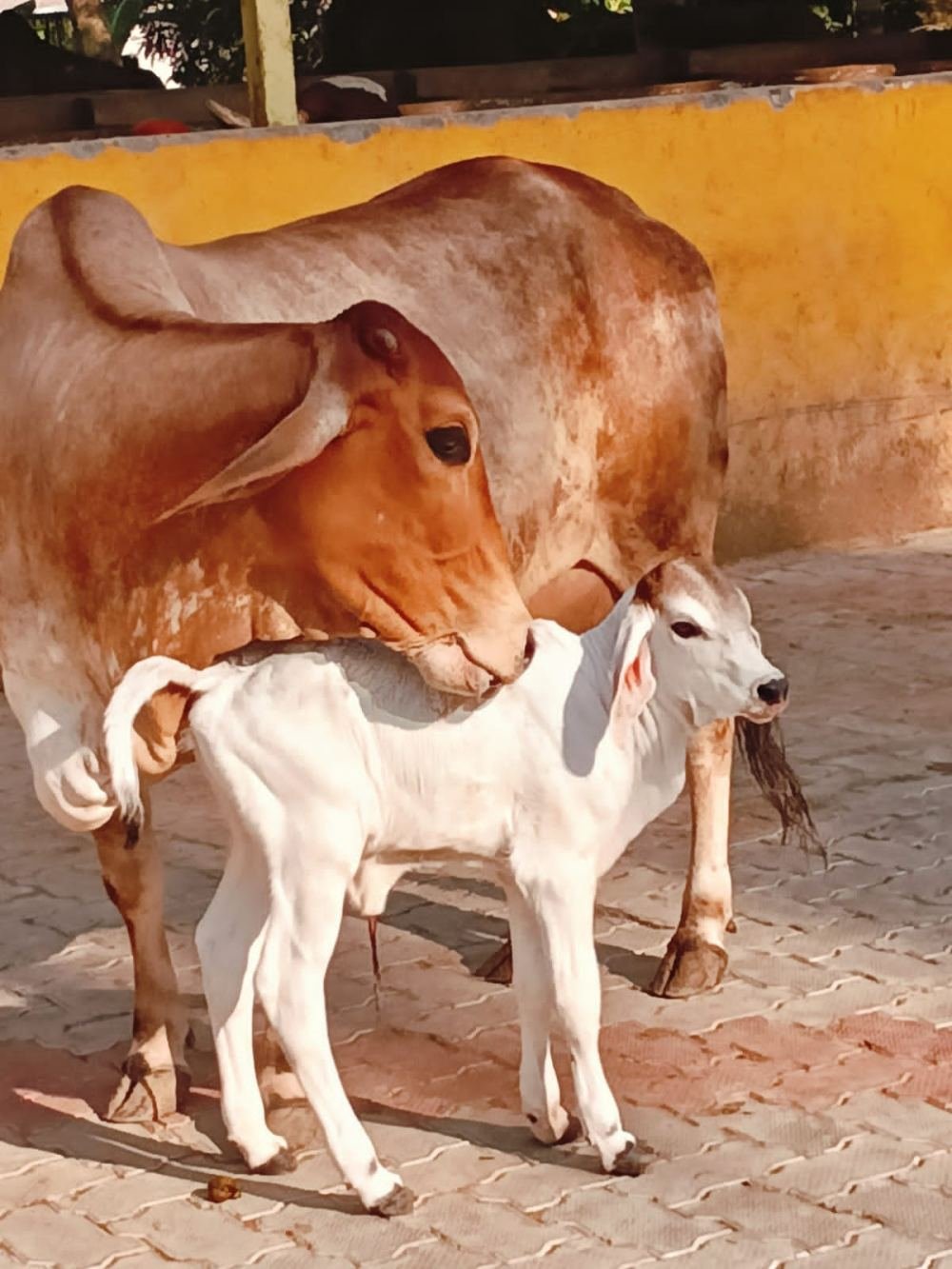
The calf drinks first.
Twice. Every time.
Before a single drop is collected, the calf is brought to its mother and allowed to feed — twice, at both milkings. What we take is what is genuinely surplus, after the animal it was made for has had its fill.
That one rule costs us volume every single day. We have never seriously considered dropping it.
- No adulteration. Nothing is added to navodita milk — not water, not powder, not preservative, not any thickener.
- No extraction. No oxytocin, no hormones, no forcing a cow to let down milk she isn't ready to give.
- Nothing removed. The cream stays in. That is why the fat reads 4–4.5% in the bottle and not 3%.
- Clean collection. Every cow is milked by hand by a trained milker, so the udder is emptied properly and hygienically at every session.
Inside our dairy
72°C to 4°C.
In under ten seconds.
Long, slow heat kills bacteria — and flavour with it. We flash-pasteurise instead: hit 72°C, then crash straight down to 4°C before the milk has time to notice. Taste and fat come through intact.
-
01
Raw, at body warmth
Milk leaves the cow at about 37°C and goes straight into the line — never left standing in a can.
37°C -
02
Up to 72°C
Plate heat exchangers lift it to seventy-two degrees. Pathogens do not survive this.
72°C -
03
Held, then homogenised
A brief hold completes pasteurisation while homogenisation breaks the fat into an even suspension.
72°C -
04
Crashed to 4°C
The same plates run cold. Seventy-two to four degrees in a single pass — the whole cycle inside ten seconds.
4°C -
05
Bottled cold
Filled into returnable glass at 4°C and loaded for the morning round. Fat holds at 4–4.5%.
4–4.5% fat
What homogenisation actually does
Raw fat globules are large and uneven, so they float and form a cream line at the top of the bottle. Forcing the milk through a fine valve at pressure shatters them into droplets small enough to stay suspended for good.
The fat isn't removed — it's redistributed. Every glass poured from the bottle tastes like the first.


What stays in
Four to four-and-a-half
percent fat. Preserved.
Standardising milk down to a fixed low fat is normal industry practice — the cream is worth more sold separately. We don't do it. What the cow gave is what goes in the bottle.
Flash pasteurisation matters here too. Holding milk hot for a long time changes how it tastes and how the fat behaves. Ten seconds does not.
- 4–4.5%fat in the bottle
- 72°Cpasteurisation temperature
- 4°Cchilled, held, delivered
- <10sheat-to-chill cycle
